

Turn a Wolf knob and the spark module ticks before the ring catches — knob to igniter switch to module to electrode to sealed brass burner. That chain is where most of our Wolf work lives. Wolf makes ranges, rangetops, cooktops, wall ovens, steam ovens and microwave drawers, and has belonged to Sub-Zero Group since 2000. The engineering is commercial-kitchen derived: dual-stack sealed burners, infrared broilers and griddles, VertiCross convection, welded steel chassis. On a Wolf, the job is combustion, ignition and high-heat control — there is no sealed refrigeration system anywhere in the catalog.


Restaurant burner engineering dropped into a residential cabinet
Wolf's burners inherit its commercial lineage: sealed brass heads with two stacked flame rings, so one burner covers a true simmer and a full sear without a separate simmer plate. Broilers and griddles are infrared — ceramic surfaces fired until they glow rather than an open flame — and oven cavities use VertiCross convection to push air in from the sides instead of straight off a rear fan. All of it is bolted into heavy welded steel. The payoff is a cooktop that survives decades of daily use. The repair consequence is mass and thermal cycling: brass, gaskets, fasteners and the harnesses routed near the burner box all move and age with every heat-up.
Wolf's cooking lines share the red knobs and very little else
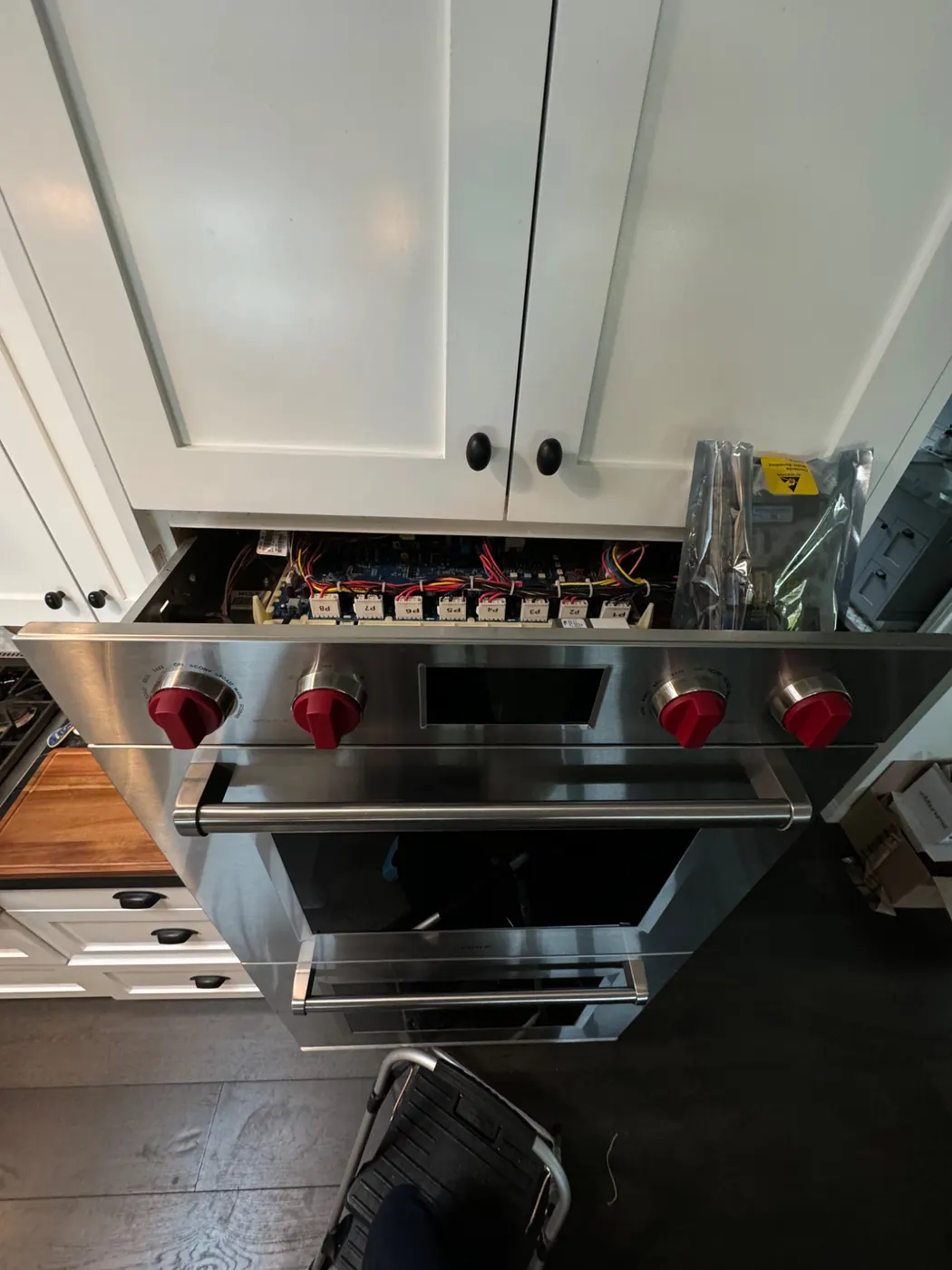
A range, rangetop, cooktop, wall oven, steam oven and microwave drawer look like one family from the front and are different machines behind the panel. An all-gas range burns gas at the burners and in the oven; a dual-fuel puts an electric convection oven under the same gas top, which means different heating elements, a different control board and a different failure list. Induction has no combustion whatsoever — inverter boards, coils and cooling fans. Rangetops sit in a cabinet with no oven beneath; cooktops are shallower again. Steam ovens add a reservoir or plumbed supply, a steam generator and scale management. Which one is in the kitchen changes the diagnostic path entirely.
How we source Wolf parts without a factory account
We hold no factory account with Sub-Zero Group and get no dealer pricing. We buy OEM Wolf components through authorized parts distributors at their published prices, ordered against the model and serial from the rating plate. That plate matters more here than on most brands: mid-production revisions mean two visually identical ranges can take different valves or a different module. Orifices are fuel-specific and never interchangeable between natural gas and propane, and a changeover is a manufacturer kit rather than a substitution. We do not fit generic gas valves to Wolf hardware, and when a board has been discontinued outright we say so before you spend anything on it.
The igniter switch is usually what failed, not the spark module
An igniter switch rides on the valve stem and gets cooked every time that burner runs. After enough years its contacts close late or weld shut, so the module fires every electrode at once, or the burner clicks with no gas behind it. Replacing the module leaves the switch untouched and the fault returns within weeks. Boil-over residue baked onto an electrode imitates the same symptom convincingly. Delayed ignition, an oven that lights and later locks out, and no-spark that appears only once the cooktop is hot all have to be reproduced at temperature rather than bench-checked cold — which is why a Wolf diagnosis takes longer than a quick meter reading.
Neither Wolf nor Sub-Zero Group has appointed, certified or endorsed us in any way. We are a local independent shop that happens to spend a lot of time in front of these ranges, and the Wolf name appears here to identify the equipment we work on, not to claim a badge we have not been given.