Sub-Zero Appliance Repair in Palos Verdes & the South Bay
Built-in Sub-Zero refrigerators, freezers, wine storage, and ice maker systems.
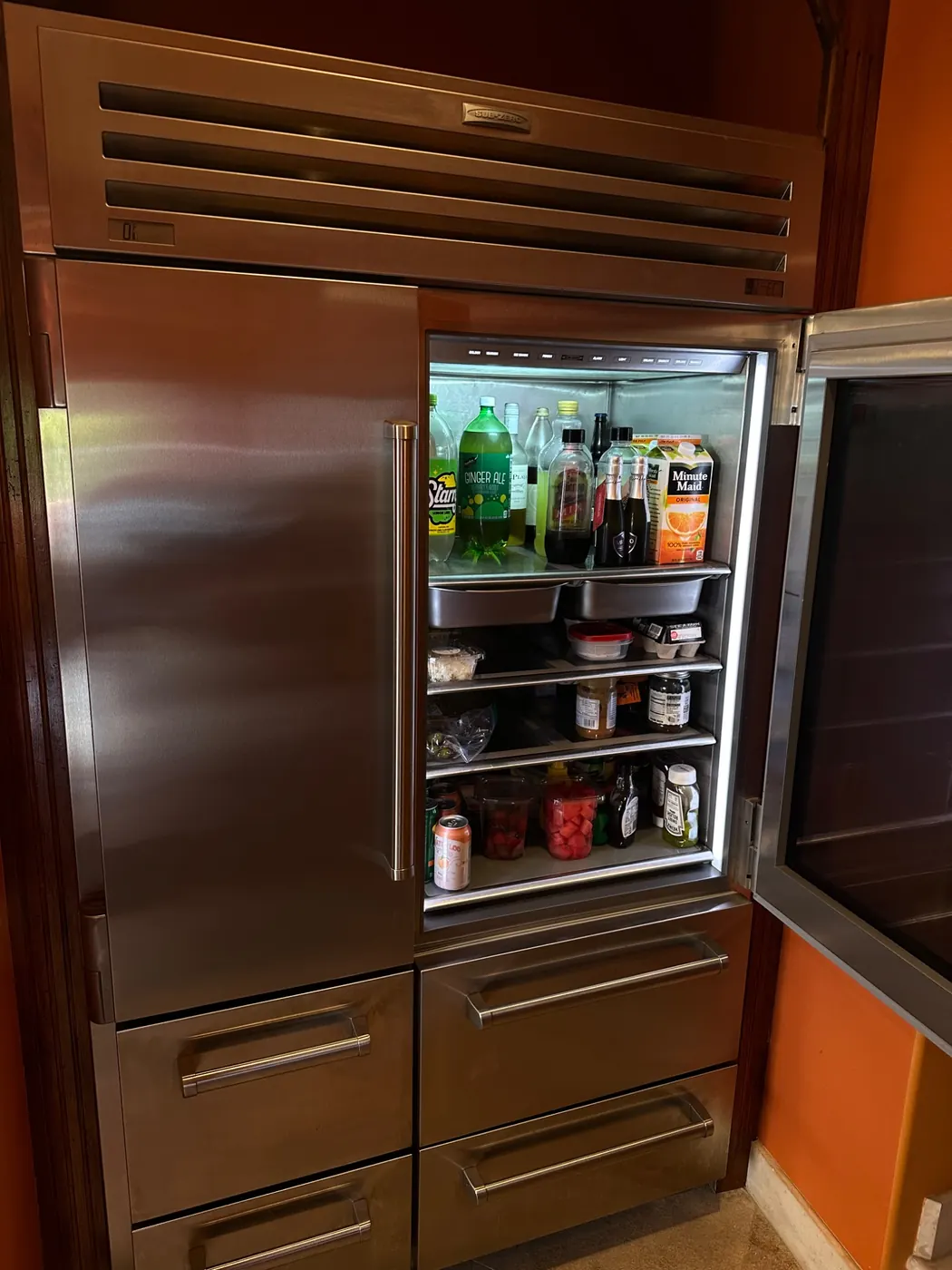
The built-in refrigerator started here: Sub-Zero introduced it in 1945 out of Madison, Wisconsin, and cold storage has stayed the company's center of gravity ever since, with Wolf cooking and Cove dishwashers added later under the same parent group. That concentration shows in the hardware — cabinets meant to be framed into millwork rather than rolled into a gap, and a parts channel that reaches back decades. It shapes the service call too. A Sub-Zero visit is refrigeration work on something that is part of the kitchen's construction, not a freestanding box we can pull out and swap.
Built-in Sub-Zero refrigeratorSub-Zero refrigeration service
Two Independent Sealed Systems, So Half the Cabinet Can Fail Alone
Most Sub-Zero built-ins use dual refrigeration: separate compressors and evaporators for fresh food and freezer, with no shared airflow between the compartments. A conventional refrigerator runs one evaporator and moves cold through a damper, so both sides drift together when something goes wrong. On a Sub-Zero, a warm fresh-food section sitting above a freezer that still holds zero is exactly what the architecture predicts — one sealed system is in trouble and the other is doing its job. That is the expected behavior, not two broken appliances. Our first move on any temperature complaint is establishing which system is involved, because that separates a fan, defrost or sensor issue from a sealed-system fault.
Fresh-food compartment warming while the freezer holds temperature normally
Freezer frosting over or running warm on its own circuit
Evaporator fan and defrost faults isolated to one compartment
Compressor or refrigerant loss affecting only one of the two systems
Control and sensor errors that report against a single system at a time
Classic, Designer, PRO, Undercounter and Wine Behave Differently in the Field
Sub-Zero's families are not variations on one chassis. Classic built-ins carry the familiar upper grille and full dual refrigeration. Designer models sit flush with the cabinetry, with tighter panel tolerances and far less forgiving access. PRO units are commercial-styled, heavier, and often glass-doored, which brings door heaters and condensation into the picture. Undercounter refrigerators, freezers and drawer modules are trapped beneath a countertop, so reaching the compressor deck can mean drawing the whole unit forward. Wine storage runs to cellar temperatures with humidity and vibration targets instead of food-safety ones, which makes a two-degree drift a legitimate complaint rather than a rounding error.
Integrated Designer units with restricted service access behind flush panels
Undercounter and drawer modules that must come out of a countertop enclosure
Wine storage zones drifting off setpoint or losing humidity control
PRO glass doors with condensation, seal or door-heater circuit problems
Ice maker modules that differ in design between built-in and undercounter lines
A Long Support Tail, Serial-Range Electronics and Superseded Components
Sub-Zero supports its equipment unusually far back, and the company builds its marketing around a design life measured in decades. In practice that means a unit from the 1990s is often a reasonable repair rather than a replacement, with two caveats worth knowing before you commit money. Electronics were revised across generations, so the correct control board depends on the serial-range build, not just the model family. And some components on older sealed systems are no longer made in original form and have to be matched by specification instead. We read the data plate before quoting, and we say plainly when a part is a superseded replacement rather than the original design.
Door gaskets, hinge cartridges and door closers on heavy panel-ready doors
Evaporator and condenser fan motors specific to the sealed system involved
Control boards revised across serial ranges within one model number
Water valves, ice maker assemblies and filter housings
Air purification cartridges and other scheduled-replacement consumables
The Cabinet Opening Is Part of the Machine
A Sub-Zero rejects heat through a vacuum-style condenser behind the upper grille, inside an opening built to defined clearances. Load that condenser with dust and pet hair, or block the grille with a decorative panel or stacked boxes, and the unit runs long, warms a few degrees and imitates a failing compressor when the real problem is a starved airflow path. Panel-ready doors supply the other half of the story: custom cabinetry hangs real weight on the hinges, and years of that show up as sag, uneven gaps and a gasket that no longer pulls closed. We check condenser condition, clearances, leveling and door alignment before condemning anything expensive.
Condenser fouling behind the upper grille causing long run times and warm cabinets
Restricted clearances or a blocked grille in a tight cabinet opening
Door sag and misalignment from the weight of custom panels
Gaskets that no longer seal on a cabinet that has settled out of level
Ice maker water lines routed through cabinetry that leak or freeze
Sub-Zero Group Inc. designs and builds this refrigeration; we only repair it. PV Appliance Repair is a South Bay company working on its own account, with no factory authorization from Sub-Zero and no role in manufacturer warranty claims. Where the Sub-Zero, Wolf and Cove marks appear on this page, they identify equipment in customers' kitchens and remain the property of the company that owns them.
Sub-Zero repair questions
One appliance with two sealed systems. On most Sub-Zero built-ins the fresh-food and freezer compartments each have their own compressor and evaporator, so one side can go down completely while the other holds temperature. That split is how the machine is designed to behave, and it actually narrows the diagnosis for us rather than doubling it.
Roughly twice a year in most South Bay homes, and more often with dogs, cats or construction dust in the house. The condenser sits behind the grille at the top of the cabinet and pulls air through a tight coil. A loaded coil makes the unit run longer, lifts cabinet temperature a few degrees and puts avoidable hours on the compressor. It is the cheapest maintenance on the machine.
Yes. Classic built-ins, Designer integrated units, PRO models, undercounter refrigerators and drawers, and wine storage. Integrated and undercounter units take longer to access safely, and we allow for that when scheduling. Rick handles most of our Sub-Zero work with nine-plus years on this equipment, and Oleg covers it as well across twelve-plus years and the widest brand range on our team.
Usually, and further back than most refrigeration brands allow. The complications are electronics revised by serial range and a few sealed-system components no longer produced in original form. We identify the exact build from the data plate first, then tell you what is available, what is a superseded equivalent, and what that means for the quote before you approve anything. Call (424) 365-9555 with the model and serial if you want that checked before we come out.
Often, yes. Wolf and Cove come from the same parent company as Sub-Zero and turn up in the same kitchens constantly. Tell us what else needs attention when you call and we will book enough time and carry the likely parts for all of it, instead of you scheduling two or three separate visits.
It scrubs odors and ethylene from the circulated air inside the cabinet. It is a scheduled-replacement consumable, not part of the refrigeration circuit, so a spent cartridge will not warm your food or stress the compressor. If a unit is running warm, the cause is somewhere else and we look at the sealed system, airflow, defrost and door seal instead.
Verified local expertise
Recent Local Repair Projects
See real repair photos and details from these nearby cities.