Viking Appliance Repair in Palos Verdes & the South Bay
Viking refrigerators, ranges, ovens, cooktops, and built-in appliances.
Fred Carl Jr. started Viking in Greenwood, Mississippi in the early 1980s to solve a personal problem: he wanted a restaurant range in his own kitchen and nobody built one. The first production range shipped in 1987 and created the residential professional category outright. Middleby, a commercial foodservice manufacturer, bought the company in 2013. That history explains the equipment in front of us — commercial gas logic, heavy-gauge steel, and assemblies that come apart in a specific order or not at all.
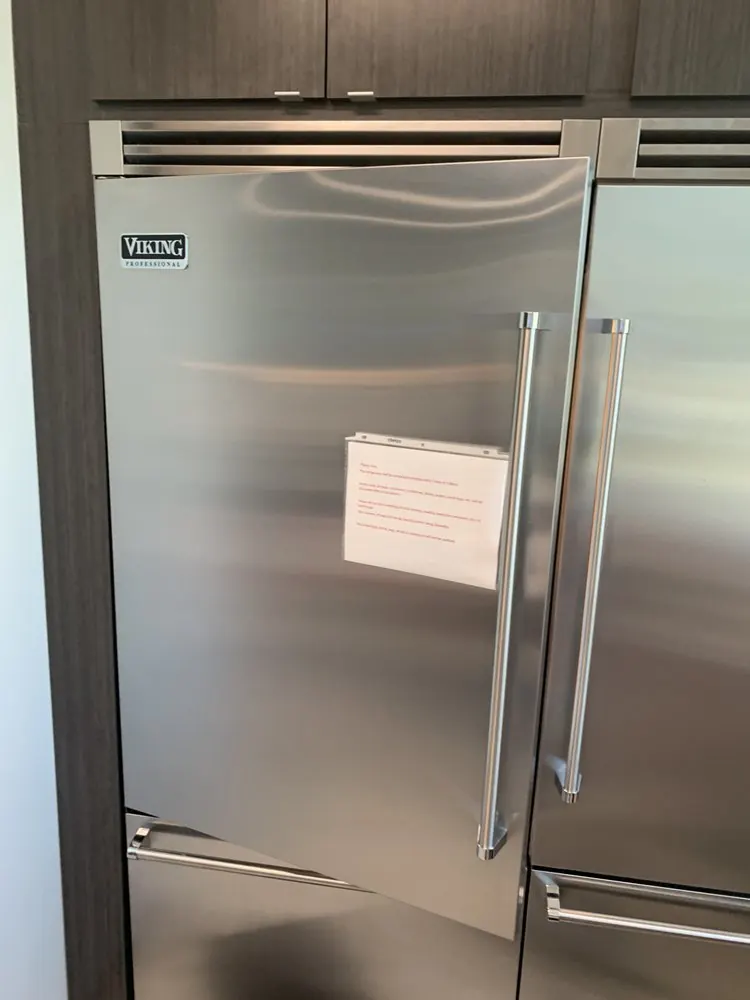
Viking refrigeratorViking rangeViking double-oven range
What Viking carried over from restaurant equipment
Viking builds to commercial habits: heavy-gauge stainless panels, cast grates that are genuinely awkward to lift, brass and aluminum burner bodies, and oven doors hung on spring-loaded hinges carrying real weight. Almost nothing is snapped together. That construction is an advantage — surfaces last decades, and burners can often be cleaned and reseated instead of replaced — but it changes the shape of the job. Getting to a valve, igniter, or convection motor usually means pulling grates, burner boxes, and control panels in the right order, then rebuilding so the door seals square and the knobs line up again.
Oven door sag or a poor seal from tired hinge springs
Burner ports fouled by spillover on open-burner rangetops
Grate and burner cap seating that quietly changes the flame pattern
Loose control panels, bezels, and knob shafts after years of heavy use
Heat-damaged trim and gaskets around a hard-worked oven cavity
Viking gas ovens use a hot-surface igniter wired in series with a safety valve. Current passes through the igniter, and only when it draws enough amperage does the valve open and admit gas. There is no standing pilot and no manual-light option. That matters enormously for diagnosis: an igniter can glow bright orange and still be too weak to pull the valve open, so judging it by eye is the most common wrong call on this brand. We measure draw under load before deciding between igniter, valve, and control. Surface burners run on an entirely separate spark and flame-sensing circuit.
Igniter glows but the oven never actually lights
Long delay before ignition, sometimes with a gas smell at start
Broil works while bake does not, or the reverse
Surface burners that keep sparking after the flame is established
Cavity temperature drifting well off the set point
Refrigeration arrived later, on platforms from outside Greenwood
Viking built its name on cooking. Refrigeration, dishwashers, and ventilation came afterward, added to complete the kitchen suite rather than grown out of the range line, and they came in on platforms engineered elsewhere — Viking-badged dishwashers, for example, have been built on Asko designs, a fellow Middleby brand. So the badge tells you very little about what sits behind the panel. A range conversation is gas pressure, igniters, safety valves, and convection motors. A refrigeration conversation is sealed-system charge, evaporator fans, defrost control, and damper and door heaters. We diagnose them as unrelated machines that happen to match.
Built-in refrigerator running warm while the freezer section stays cold
Frost accumulation pointing to a defrost circuit or door-seal fault
Hood blower or control failure on the ventilation above a Viking range
Drain, pump, and control faults on Viking-badged dishwashers
Grill igniters and valves corroding in Palos Verdes coastal air
Parts, serial breaks, and the Middleby-era supply chain
Viking runs long production cycles with mid-series revisions, so the model and serial plate decides the part, not the model name on the door. On ranges the tag usually hides behind the kick plate or inside the door frame; on refrigeration it sits on an interior wall. Many components from the Viking Range Corp years supersede into current Middleby-era numbers, and some legacy pieces are special-order only. We photograph the tag, confirm the correct revision before anything is ordered, and tell you plainly when a part carries a lead time rather than promising a same-day outcome the supply chain cannot support.
Wrong part ordered from the model number alone, ignoring the serial break
Superseded numbers on units built before the 2013 ownership change
Special-order lead times on discontinued cooking components
Control boards that must match one specific revision to work
Aftermarket burner and hinge hardware that alters fit or flame quality
We are not on Viking's authorized service list, and we hold no service agreement with Viking Range, LLC or Middleby. Nobody at the factory reviews our work, trains our technicians, or sends us jobs. We name Viking on this page because that is the equipment sitting in your kitchen and the engineering our diagnostic approach is built around — not to suggest the manufacturer stands behind us.
Viking repair questions
They are not just trim levels. Viking has used series names to mark different build generations and levels of construction, and components rarely carry across them cleanly, even when two units look nearly identical in a kitchen. Burner assemblies, hinges, and control boards are the usual places where the difference bites. That is why we ask for the model and serial rather than the series name when you call (424) 365-9555.
Most models can, using the manufacturer's model-specific conversion kit — it is orifice work, a regulator change, and on some units air shutter adjustment. What we see more often is the aftermath of a conversion done partially or with the wrong kit: lazy yellow flames, soot, an oven that under-heats, symptoms people blame on a bad burner. We check the rating plate against the gas actually supplied before chasing anything else.
No. Viking residential units are certified for home installation and are not commercial-rated equipment, whatever the styling suggests. What carried over from that world is design philosophy — safety-valve gas control, serviceable burner hardware, structure meant to be taken apart and put back rather than replaced. The practical change since 2013 is on the parts side, where Viking components now move through Middleby's supply network.
Usually the body outlives the electronics. The steel chassis, burner castings, and door hardware on a Professional-series range are typically still sound at that age, while ignition components, thermostats, and control boards are what wear out. Rick has spent 9+ years concentrating on Sub-Zero, Viking, and Wolf and works on these regularly. The real question is parts availability for that specific serial range, and we check that before recommending anything.
No, and treating them as one brand is where diagnosis goes wrong. The cooking equipment is Viking's own engineering lineage; the refrigeration is a separate platform with its own failure vocabulary — sealed system, defrost circuit, airflow, door heaters. Oleg, with 12+ years and the widest brand range on our team, tends to take the refrigeration side. Have the model and serial from the unit itself, not from the range, when you call.
Verified local expertise
Recent Local Repair Projects
See real repair photos and details from these nearby cities.