
Before checking anything behind or underneath the fridge: unplug it first if you're touching electrical connections, and give food safety some thought — if it's been more than a few hours without cooling, check temperatures before deciding what's still safe to keep.
1. Dirty or blocked condenser coils
The condenser coils release the heat that's pulled out of the fridge. When they're coated in dust, pet hair, or are blocked by nearby cabinetry, they can't shed heat properly and cooling suffers — sometimes gradually, sometimes to the point the compressor overheats and shuts off.
DIY checks: Unplug the fridge, locate the coils (behind a lower kickplate on most models, or on the back panel on older units), and vacuum off visible dust and debris. Make sure there's clear airflow space around the unit.
When to call a pro: If the coils are clean and airflow is clear but cooling still isn't right, the cause is elsewhere and worth having tested directly rather than guessing further.
2. Evaporator fan not running
The evaporator fan circulates cold air from the evaporator coil (usually behind a panel in the freezer) throughout the fridge and freezer. If it's not spinning, the compressor can be running fine and the unit still won't get cold.
DIY checks: Listen closely near the back of the freezer compartment for fan noise when the door is closed (some models pause the fan when the door opens). Silence where you'd expect a hum is a useful clue.
When to call a pro: The fan sits behind an interior panel and often near the evaporator coil itself, so diagnosing and replacing it usually means partially disassembling the freezer compartment.
3. Condenser fan not running
The condenser fan pulls air across the condenser coils to help release heat, working alongside the coils rather than instead of them. A failed condenser fan produces the same kind of heat-buildup problem as blocked coils, even when the coils themselves are clean.
DIY checks: With the fridge unplugged and pulled out, check the compressor compartment (usually behind the lower rear or bottom panel) for a small fan near the compressor and coils, and look for anything physically blocking the blade.
When to call a pro: Fan motor replacement in this area means working close to the compressor and sealed system components — worth having tested and replaced correctly rather than repeatedly guessing.
4. Failed start relay or capacitor
The compressor needs a jolt from a start relay (and sometimes a start capacitor) to actually get running each cycle. When that component fails, the compressor may hum and try to start without succeeding, or not attempt to start at all.
DIY checks: Listen for a humming or clicking sound near the compressor that doesn't resolve into a running motor — that's a fairly specific symptom worth mentioning to a technician.
When to call a pro: Testing a start relay or capacitor safely requires the right tools and knowledge of the specific compressor circuit — this isn't a component to swap by trial and error.
5. Thermostat or temperature control fault
The thermostat (or an electronic temperature sensor and control board on newer models) tells the compressor and fans when to run. A fault here can mean the system never gets the signal to cool, even though every individual part is otherwise capable of working.
DIY checks: If your model has a temperature dial, confirm it wasn't accidentally turned down or off. Beyond that, thermostat and sensor testing isn't usually a visual check you can do from the outside.
When to call a pro: Confirming a thermostat or control board fault requires testing components against expected values — worth diagnosing properly rather than replacing parts on a guess.
6. Refrigerant leak or sealed system failure
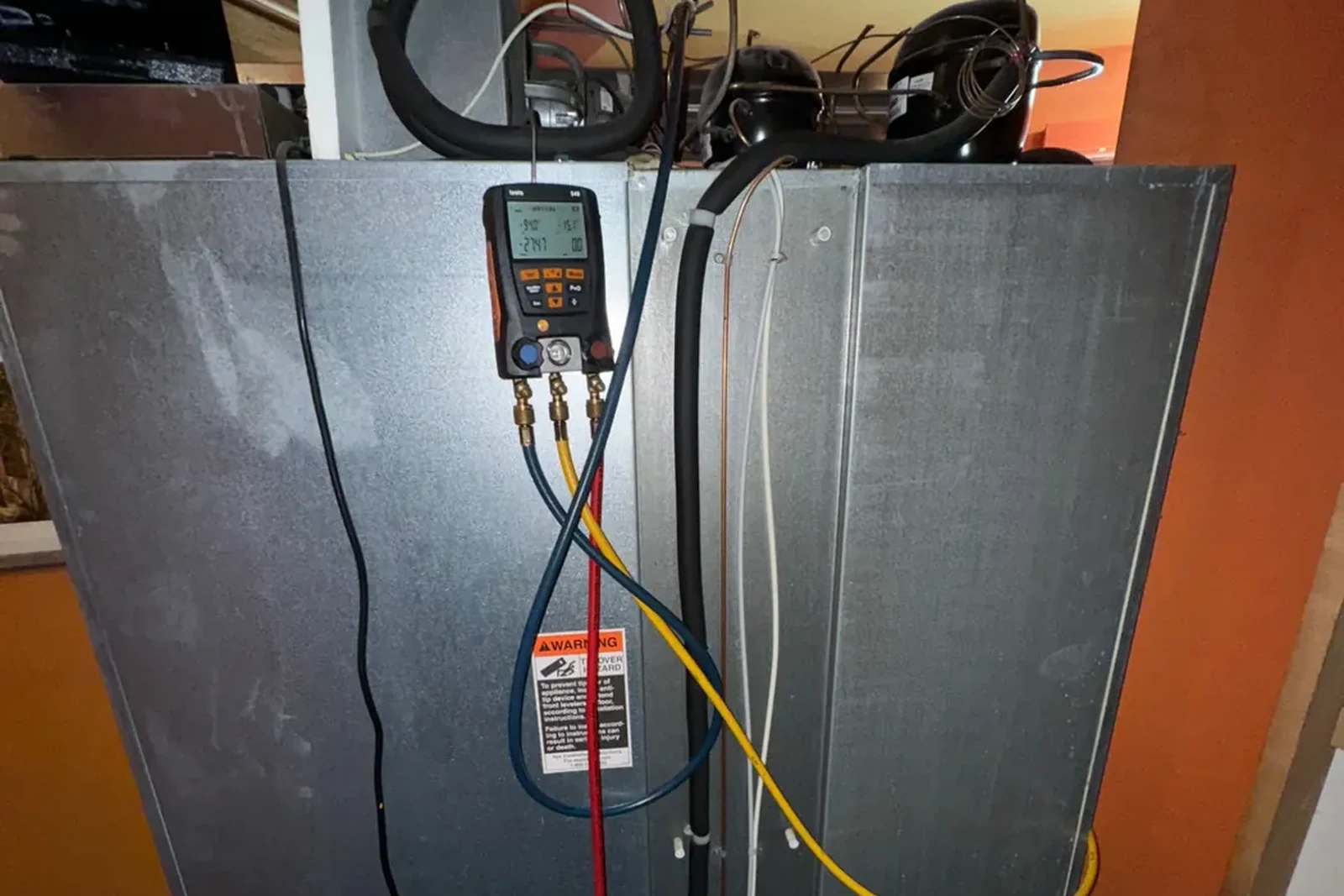
The sealed system — compressor, condenser, evaporator, and the refrigerant lines connecting them — is a closed loop. A leak, a failed compressor, or a restriction somewhere in that loop is the most serious category of cooling failure, and the one that needs the most specialized diagnosis.
DIY checks: There isn't a reliable visual DIY check for sealed system problems — this is diagnosed with gauges and electrical testing, not by looking at the unit.
7. Blocked internal air vents
Even with everything else working, overpacking the fridge or freezer — or storing items directly against the internal vents that carry cold air between compartments — can restrict airflow enough to cause uneven or insufficient cooling.
DIY checks: Check that vents inside both the fridge and freezer compartments (usually small slotted openings on the back or side walls) aren't blocked by food packages, and leave some clearance around the back wall.
When to call a pro: If vents are clear and cooling is still off, the cause is mechanical or electrical rather than airflow, and it's time to move to the causes above.