
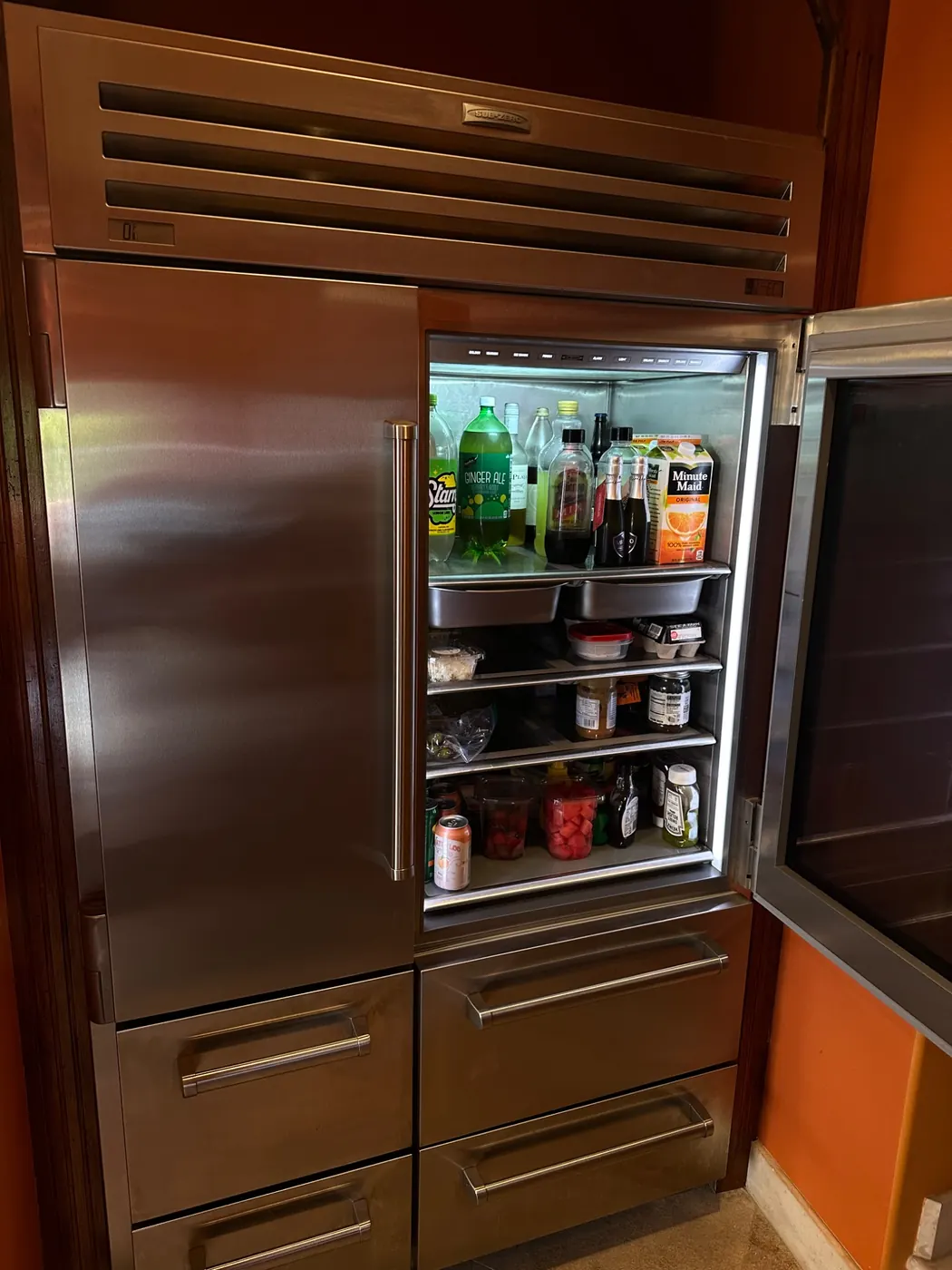
Where the water actually appears is a useful clue: inside the fridge compartment, underneath the unit, or condensation on the outside cabinet each point toward a different cause below.
1. Clogged or frozen defrost drain
Sub-Zero refrigerators periodically defrost the evaporator coil, and that meltwater is supposed to run down a drain tube to a pan where it evaporates. When that drain gets blocked by ice or debris, the water backs up instead — often showing up as pooling inside the fridge or dripping down the back interior wall.
DIY checks: Check the drain opening at the back of the interior compartment (location varies by model) for visible ice or blockage. Don't force anything into it — clearing it safely usually requires knowing the exact drain path for your model.
When to call a pro: If the drain is iced over repeatedly or you can't locate/access it safely, that's worth a technician visit rather than repeated DIY clearing.
2. Door seal not sealing properly
A worn or misaligned door gasket lets warm, humid air into the cabinet. That extra moisture can condense and refreeze inside, and when it later melts, it shows up as water that seems to come from nowhere.
DIY checks: Close the door on a piece of paper at several points around the perimeter — if it pulls out easily anywhere, the seal has a gap there.
When to call a pro: Gasket replacement is a straightforward fix once confirmed, but it's worth confirming the seal is the actual cause rather than just cleaning up water repeatedly.
3. Water filter or water line connection
On models with a water dispenser or ice maker, a loose fitting, cracked filter housing, or a filter that wasn't fully seated after a recent change is a common and often easy-to-miss leak source.
DIY checks: If you changed the filter recently, confirm it's fully seated and the housing is closed properly. Look for visible moisture around fittings behind or underneath the unit.
When to call a pro: A cracked filter housing or a fitting that won't seal even when reseated needs the actual part replaced.
4. Ice maker fill valve or line fault
A failing fill valve can let water trickle through when it shouldn't, or a cracked line feeding the ice maker can leak directly — both can show up as water that seems unrelated to the ice maker at first.
DIY checks: There isn't a safe visual DIY check for the fill valve itself, since it's part of the water supply system behind the panel.
When to call a pro: Fill valve and water line issues involve water supply connections behind the unit — worth having tested and repaired properly rather than guessing which fitting is at fault.
5. Condensation from inadequate cabinet clearance
Sub-Zero's built-in, panel-ready design needs specific airflow clearance around the cabinet to work as designed. When a unit is installed too tightly or the vent grille is blocked, condensation can form on the exterior cabinet or nearby cabinetry — which looks like a leak but isn't a fault with the appliance itself.
DIY checks: Check that the vent grille (usually at the top or bottom of the unit) is clear and that there's the manufacturer-specified clearance around the cabinet.
When to call a pro: If clearance and airflow look correct and exterior condensation continues, it's worth having assessed — sometimes it's a ventilation fix rather than a repair.